on emerging workplace trends
leverage Mellow for growth
A Practical Guide for Employers on US Work Visas and Work Permits
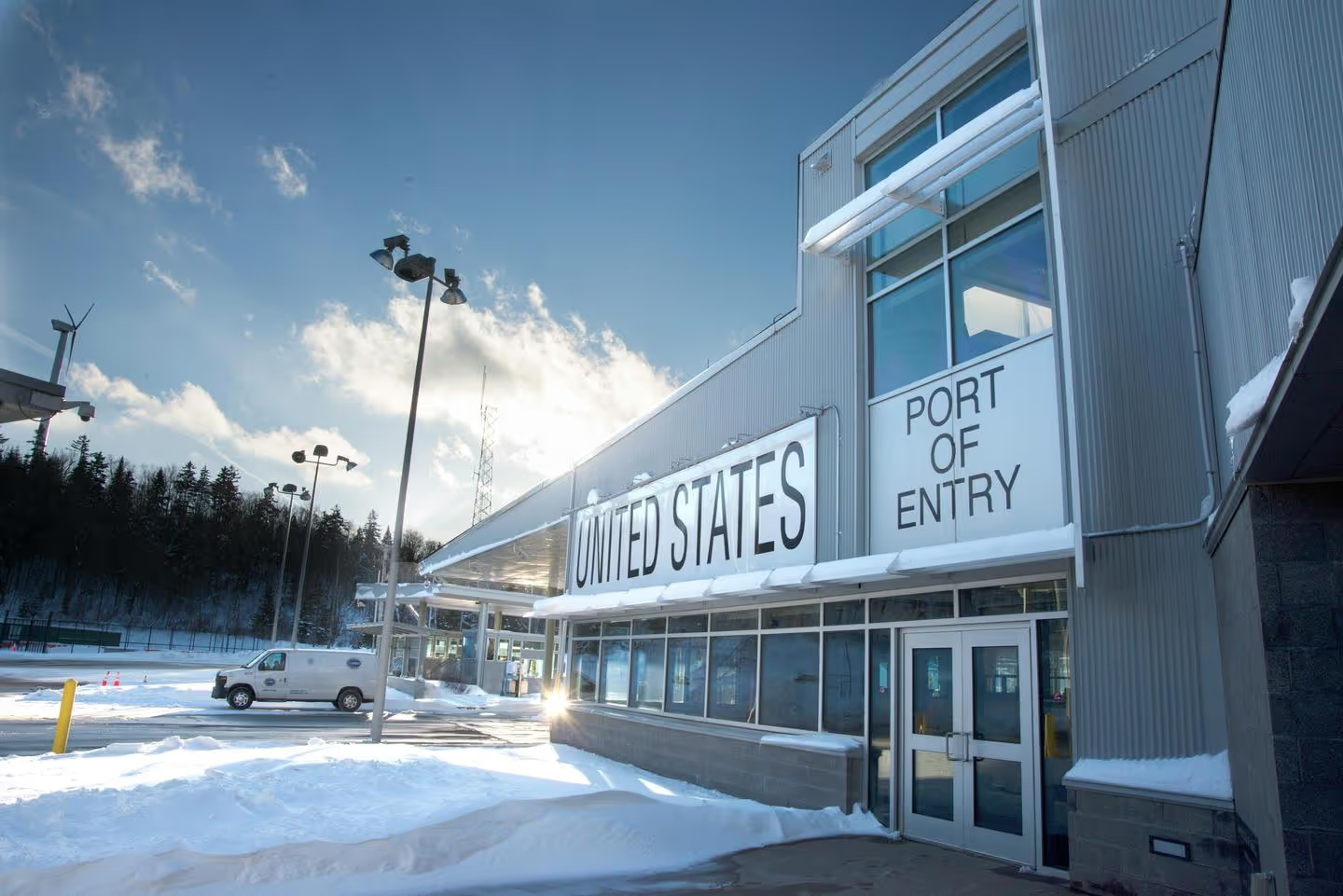
With the need to recruit or transfer foreign talent into the United States, business executives and human resources department makers have to wade their way through an intricate yet mandatory industry when interacting with the United States immigration system. It is imperative to make sure that your international employees and contractors are at least legally authorized to work so as to avoid harsh fines and penalties on the part of the U.S Citizenship and Immigration Services (USCIS) and Immigration and Customs Enforcement (ICE). This is an in-depth tutorial, which dissects the necessary distinctions between work permits and visas, outlines the key types of U.S. work permission, and provides useful actions to take in cases where the employer sponsors foreign employees. The main question that an employer is worried about is: what is a work visa in the USA and what my legal responsibilities are?
Understanding Work Permits vs. Work Visas
The terms work visa and work permit (Employment Authorization Document, or EAD) are often used interchangeably, but they represent two distinct legal concepts in the U.S. immigration framework.
| Feature | Work Visa (Non-Immigrant or Immigrant) | Work Permit (EAD - Employment Authorization Document) |
|---|---|---|
| Purpose | Grants permission to enter the U.S. (or change status) and work for a specific employer or in a specific field. | Grants permission to an individual already in the U.S. to accept employment with any U.S. employer (or be self-employed). |
| Status | Primary immigration status (e.g., H-1B, L-1). | An ancillary benefit granted based on a separate primary status (e.g., asylum applicant, dependent of an H-1B holder, Green Card applicant). |
| Sponsor | Generally requires a U.S. employer(petitioner) to file on the beneficiary's behalf. | Usually filed by the individual (applicant) themselves. |
| Form Used | Form I-129 (Petitions for Non-Immigrant Worker) or I-140 (Immigrant Petition). | Form I-765 (Application for Employment Authorization). |
A work visa (like H-1B) is the legal status that allows the individual to enter and perform the work; a work permit (EAD) is a physical card that serves as proof of employment authorization for certain groups of people who are not in primary employment visa status (e.g., spouses of L-1 holders, students on Optional Practical Training (OPT), or those awaiting a Green Card). Who can apply for a work permit in the USA? Those whose immigration status permits them to work, even if that status isn't a dedicated "work visa."
Types of Work Visas in the United States
U.S. work visas are broadly divided into Temporary (Non-Immigrant) and Permanent (Immigrant) categories. As an employer, you will most frequently encounter temporary visas.
Temporary Non-Immigrant Work Visas
These visas allow individuals to live and work in the U.S. for a specific, limited duration.
H-1B Visa (Specialty Occupations)
- Purpose: For highly skilled foreign workers in specialty occupations that require a bachelor's degree or its equivalent (e.g., technology, engineering, medicine, finance).
- Employer Requirement: The employer must pay the employee at least the Prevailing Wage for that occupation in the geographic area.
- Key Challenge: The H-1B program is subject to an annual cap (lottery), making it highly competitive and uncertain.
H-2A Visa (Seasonal Agricultural Workers)
- Purpose: For temporary or seasonal agricultural work.
- Employer Requirement: Requires proof that there are not enough U.S. workers available to perform the labor.
H-2B Visa (Non-Agricultural Workers)
- Purpose: For temporary or seasonal non-agricultural work (e.g., hospitality, landscaping).
- Key Challenge: Subject to a low annual cap and requires the employer to prove the need is temporary.
L-1 Visa (Intracompany Transferee)
- Purpose: For managers, executives (L-1A), or employees with specialized knowledge (L-1B) transferring from a foreign parent, subsidiary, affiliate, or branch to a U.S. office.
- Employer Requirement: The employee must have worked for the related company abroad for at least one continuous year in the preceding three years.
- Advantage for Employers: L-1A allows for faster pathway to a Green Card (EB-1C category).
O-1 Visa (Individuals with Extraordinary Ability)
- Purpose: For individuals with demonstrated extraordinary ability in the sciences, arts, education, business, or athletics.
- Employer Requirement: Requires evidence of sustained national or international acclaim.
- Advantage: Not subject to annual numerical caps.
P-1 Visa (Athletes, Entertainers)
- Purpose: For internationally recognized athletes and entertainers performing at a specific event or competition.
TN Visa (NAFTA/USMCA Professionals)
- Purpose: For citizens of Canada and Mexico entering the U.S. to engage in pre-arranged business activities for U.S. or foreign employers.
- Advantage: Simpler application process; no annual cap, and in some cases, can be processed directly at the port of entry. Limited to professions listed in the USMCA agreement.
J-1 Visa (Exchange Visitors)
- Purpose: For educational and cultural exchange programs, including interns, trainees, scholars, and specialists.
- Employer Requirement: The employer must participate in a DOL-approved program.
E-1/E-2 Visas (Treaty Traders and Investors)
- Purpose: For nationals of countries with which the U.S. maintains treaties of commerce and navigation, entering to carry on substantial trade (E-1) or invest substantial capital (E-2).
- Employer Requirement: Applies mostly to owners and key employees of the trading or investing company.
Permanent Work Visas (Employment-Based Green Cards)
These visas provide permanent residency (Green Card) based on an employment relationship. The process is lengthy and typically involves three steps: Labor Certification (PERM), Immigrant Petition (Form I-140), and Adjustment of Status/Consular Processing.
EB-1 Visa (Priority Workers)
- EB-1A: Individuals with extraordinary ability (no employer required).
- EB-1B: Outstanding Professors and Researchers (requires job offer and employer sponsorship).
- EB-1C: Multinational Managers or Executives (L-1A equivalent, requires employer sponsorship).
- Advantage: Generally avoids the long backlogs seen in other categories.
EB-2 Visa (Advanced Degree or Exceptional Ability)
- Purpose: For professionals holding an advanced degree (Master's or higher) or a Bachelor's degree plus five years of progressive experience, or individuals with exceptional ability.
- Requirement: Typically requires the employer to obtain a PERM Labor Certification to prove no qualified U.S. workers are available.
- Key Option: National Interest Waiver (NIW) allows applicants to self-petition without an employer or PERM if their work is in the national interest.
EB-3 Visa (Skilled Workers, Professionals, and Other Workers)
- Purpose: For skilled workers (requiring at least two years of training or experience), professionals (requiring a bachelor's degree), or unskilled workers.
- Requirement: Requires PERM Labor Certification and employer sponsorship. Generally has the longest waiting times (backlogs).
EB-4 Visa (Special Immigrants)
- Purpose: For special categories, including religious workers, certain former U.S. government employees, and others.
EB-5 Visa (Immigrant Investors)
- Purpose: For foreign investors who invest a significant amount of capital (typically $1.05 million or $800,000 in a Targeted Employment Area) in a new commercial enterprise that creates or preserves at least 10 full-time jobs for U.S. workers.
Eligibility Requirements for Work Permits and Visas
The skills of knowing who should receive a working permit in the USA and how to check eligibility are among the basic duties of the employers under the federal law.
Who Needs a Work Permit in the United States
Any person who is not a U.S. citizen or Lawful Permanent Resident (Green card holder) usually requires some kind of work authorization in order to be a legally employed person within the U.S. This authorization can be:
- A Non-Immigrant Work Visa (e.g., H-1B, L-1).
- A Work Permit (EAD) based on their primary status (e.g., dependent spouse, asylum status).
Important Note for Remote Work: When an employee is working with an American company (including a foreign contractor) physically outside the United States, then they do not necessarily require a work visa or work permit issued in the United States. They are however required to enter the U.S. on the proper non-working visa (usually B-1 Business Visitor) status in the case they are entering the U.S. to hold meetings or train in the U.S.
Employment Eligibility Verification (Form I-9)
It is mandatory that all U.S. employers, irrespective of the size of their company or the immigration status of the employee, provide Form I-9, Employment Eligibility Verification, correctly and save it for all new employees (both citizens and non-citizens).
- Employer Obligation: The employer must verify the employee's identity and their authorization to work in the U.S. by reviewing specific documentation (e.g., U.S. Passport, Green Card, or a combination of a driver's license and EAD card).
- E-Verify: While voluntary for most employers, the E-Verify system (an internet-based system that compares I-9 information with records from the Department of Homeland Security and Social Security Administration) is mandatory for federal contractors and some states.
Failure to properly complete, retain, or present the I-9 form upon inspection can result in severe civil and criminal penalties.
Common Hiring Scenarios in the United States
Employers encounter different visa issues based on whether they are initiating the sponsorship, hiring a contractor, or relocating an existing staff member.
Sponsoring a Foreign Employee (H-1B, EB-2/EB-3)
- Process: This is the most complex scenario, requiring the employer to act as the petitioner.
- Determine Suitability: Verify the job meets the requirements for a specific visa (e.g., specialty occupation for H-1B).
- Labor Condition Application (LCA) / PERM: For H-1B, file the LCA. For EB-2/EB-3, undertake the complex PERM Labor Certification process to test the U.S. labor market.
- Petition Filing: File the appropriate petition (Form I-129 or I-140) with USCIS.
- Visa Stamping/Adjustment of Status: Once approved, the employee obtains the visa at a U.S. Consulate abroad or adjusts their status if already in the U.S.
Hiring a Foreign Contractor
- Independent Contractor Status: The individual must genuinely meet the legal definition of an independent contractor (no supervision, sets their own hours, provides their own tools).
Location Matters:
- Contractor is OUTSIDE the U.S.: No U.S. work visa or permit is required. The U.S. company will issue a Form 1099 or Form 1042-S for tax purposes.
- Contractor is INSIDE the U.S.: They must independently hold a valid work authorization (EAD or a specific visa that allows self-employment), otherwise, they are working illegally. The U.S. company cannot simply hire an unauthorized person as a "contractor" to circumvent visa laws.
Relocating an Existing Employee (L-1)
- Process: This usually involves an L-1 visa that is advantageous since it does not involve the process of LCA and PERM.
- Establish Relationship: Be sure that there is a sufficient parent/subsidiary/ affiliate relationship between the foreign entity and the U.S. entity.
- Qualify Employee: The employee must have managerial/executive or specialized knowledge experience (one year within three) of the kind.
- File Petition: File Form I-129 with USCIS.
- New Office Rule: In case the U.S. office is still new (has not been operating for over one year) the L-1 petition should be filed according to the New Office rule that includes some specialized evidence on business plans and investment of capital.
Fees and Processing Times for Work Permits and Visas
Immigration incurs high expenses and timeframes and has to be covered by the employer in the United States.
Visa Application Fees
Prices are extremely different across the type of visa, although they typically involve the following:
- Filing Fees: Basic I-129 or I-140 fees (paid to USCIS).
- Fraud Prevention and Detection Fee (H-1B/L-1): An additional fee intended to deter fraud.
- ACWIA Fee (H-1B): An education and training fee, applicable to most H-1B petitions.
- Premium Processing: An optional, costly fee (paid to USCIS) to guarantee a decision within a certain timeframe (usually 15 calendar days).
- Attorney Fees: Legal fees for preparing and filing the complex petitions, which can be thousands of dollars per case.
General Rule: The employer in law is obligated to contribute some charges (such as the ACWIA fee) without being able to transfer it to the employee.
Processing Times and Renewal Periods
The processing times are changeable and may take the form of several weeks (Premium Processing) to several months or years (in case of Green Card categories having backlogs).
- H-1B: The first approval is a maximum of three years; the total allowance is six years (it can be extended to Green Card applicants).
- L-1: It has initial approval up to three years; the maximum duration is five or seven years, respectively L-1B and L-1A.
- EAD (Work Permit): It may also take several months to process and the card is normally pasted on a one or two year basis and has to be renewed. It is important to ensure that the EAD renewal is timely otherwise the interruption in being employed may arise.
Challenges and Tips for Employers
The immigration journey in the US needs to be done tactfully and carefully to avoid the risks of violating the law.
Challenges
- H-1B Cap Uncertainty: The lottery nature of the annual process renders the process of planning specialty hiring very unpredictable.
- Regulatory Scrutiny: USCIS and ICE focus on petitions, in particular in the L-1 and H-1B categories, typically leading to the Requests of Evidence (RFEs).
- Public Charge Rule and Intent: It can be a thin line of the law to make sure that the employee has the right non-immigrant intent (temporary stay) and has the intention to stay in the country long-term (Green Card).
- Remote Work Compliance: In the case with remote employees on the visa, the employer has to make sure that the employee is working at the state of the office that is completed according to the specified legal area of the visa petition (LCA).Any action has to be amended.
Tips for Employers
- Start Early: The duration of immigration procedures, in particular, of Green Cards (PERM), is 1-3 years. Start preparation of permanent residency track once the employee joins.
- Document Diligently: Keep detailed records of all petitions, LCAs, and most importantly, completed Form I-9s and supporting documents. Use a retention system that ensures easy retrieval in case of an ICE audit.
- Consult Legal Counsel: Always engage an experienced immigration attorney for filing petitions. Do not rely solely on HR staff, as minor errors can lead to costly delays or denials.
- Pay the Prevailing Wage: Faithfully comply with the prevailing wage provisions in the Labor Condition Application (LCA) of the H-1B and the PERM process of the Green Cards. Not doing so is a widespread cause of infraction.
- Offer Alternative Paths: Use non-cap visas such as L-1 (where available) or O-1 as an alternative to running H-1B through the lottery in order to ensure important talent makes it through.
Digital Nomad Visa in the United States
As of now, the United States does not offer a dedicated "Digital Nomad Visa."
Foreign nationals seeking to work remotely for a foreign company while physically present in the U.S. must still use an existing visa category, typically:
- B-1 (Business Visitor): This visa does not authorize work for a U.S. company but may permit limited activities like attending meetings, conferences, or internal training for a foreign employer. Taking a remote job for a foreign company while residing in the U.S. on a B-1 visa is often considered an unauthorized change of status and is generally risky.
- Other Visas: The safest (but complex) routes are often through derivative statuses (e.g., as the spouse of an L-1 or E-2 holder who has an EAD) or by obtaining a primary employment visa like H-1B or O-1.
The absence of a Digital Nomad Visa means U.S. companies hiring remote global talent must prioritize legal compliance based on the physical location of the employee, ensuring they do not perform work while illegally present in the U.S. on a tourist or business visitor visa.