on emerging workplace trends
leverage Mellow for growth
How to Hire Independent Contractors in Morocco Legally Fast
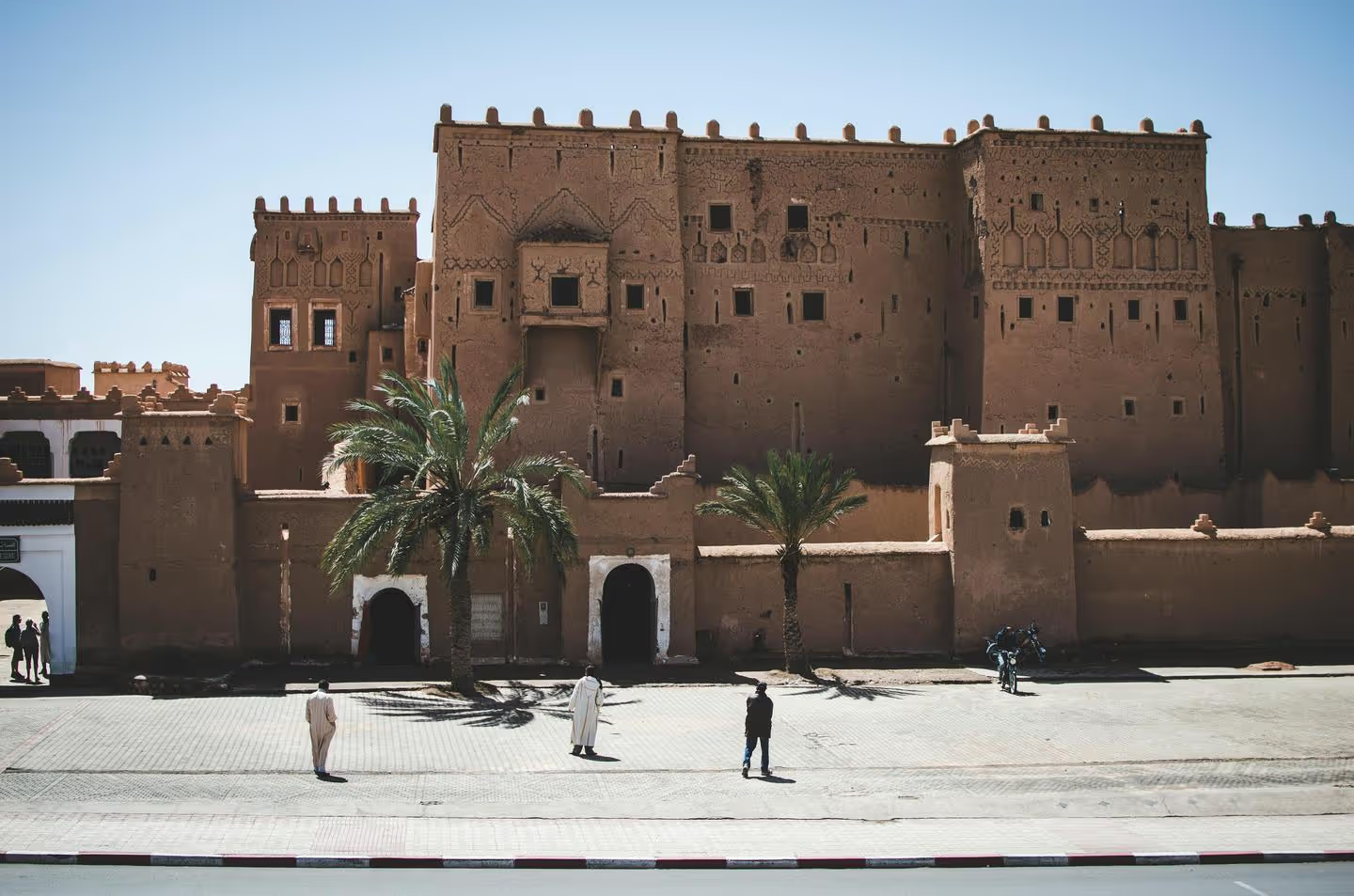
Morocco has become one of the most competitive nearshoring centers of the European and North American firms within a short time. The Kingdom is a rich source of talent in the field of IT, digital marketing, and business process outsourcing (BPO), as it has a strategic location (GMT+1 time zone), a multilingual workforce that speaks French, Arabic, and more and more English, and a strong infrastructure. In Morocco, the most responsive solution to scaling is finding independent contractors to manage the company without the administrative overhead of opening a local subsidiary in Casablanca or Rabat.
However the Moroccan legal environment is rigidly safeguarding the rights of the workers in accordance with the Code du Travail (Law No. 65-99). By 2026, the authorities have increased their attention on the topic of misclassification, the phenomenon of treating de facto employees as independent contractors in order to escape high social security payments. In an international business, the only way to sail through these waters is to have a clear idea of the Auto-entrepreneur regime, tax withholding, and stringent exchange control conditions.
Overview of Independent Contracting in Morocco
The Moroccan legal system of independent contracting was transformed with the advent of the Statut de l'Auto-entrepreneur (Law No. 114-13). This status enables people to act as a one-person business entity with fewer tax and accounting requirements.
To the Moroccan administration (Inland Revenue and the CNSS), an independent contractor is not an employee, but a business partner. Their operations are based on Contrat de Prestation de Services (Service Agreement) instead of the employment contract. By 2026, most of the Moroccan freelancers and remote specialists rely on the Auto-entrepreneur status to offer services to foreign clients in a legal manner.
Benefits of Hiring Independent Contractors
For a growing company, the contractor model in Morocco provides several strategic advantages:
1. Lower Financial Overhead
Morocco has high non-salary expenses associated with hiring a full-time employee. Generally, the amount of gross salary paid by the employer towards social security (CNSS) and mandatory health insurance (AMO) is about 21-25 percent. Contractors on the other hand do not pay any social insurance or taxes, so the company hiring has to pay a set sum of money at the end of the work.
2. Speed of Engagement
It takes weeks of legal documents, bank account opening and appointment of local directorship, to establish a local Limited Liability Company (SARL) in Morocco. The onboarding of an independent contractor may take place within 48 hours after the status of an Auto-entrepreneur is confirmed and a service agreement is signed.
3. Trial and Scalability
The contractor model gives you the opportunity to trial a specialist on a given project without engaging into a long term employment relationship. This comes in especially handy with tech startups where the scopes of projects may change very quickly.
Key Industries for Independent Contractors in Morocco
The Digital Morocco 2030 project has given rise to an influx of specialized talent in a number of strategic sectors in Morocco:
- Information Technology: Full-stack developers (specializing in PHP/Laravel, JavaScript, and Python), cybersecurity experts, and cloud architects.
- Multilingual Customer Support: Morocco is a global leader in BPO, providing high-quality support in French, Spanish, and English.
- Creative and Digital Media: UX/UI designers, content creators, and SEO specialists who cater to the European market.
- Engineering and Consulting: Industrial engineering and business consulting for the automotive and aeronautics sectors.
How to Hire Independent Contractors in Morocco
To hire in the most legal and risk-reduced way, you have to go through a systematic procedure that focuses on the B2B character of the connection.
Steps to Hire an Independent Contractor
- Verify the Auto-entrepreneur Card: Always ask for a copy of the contractor's Carte d'Auto-entrepreneur and their Identifiant Commun de l’Entreprise (ICE). This confirms they are a registered business entity and are authorized to issue invoices.
- Draft a Precise Statement of Work (SOW): Specify the project based on deliverables, not on hours. Define the standards of the Act of Acceptance- the terms in which a task is regarded as being completed and payable.
- Conduct Business-Focused Interviews: Do not ask questions regarding cultural fit or long-term career aspirations in your company, and it is a characteristic of employment relationships. Concentrate on technical capabilities, previous portfolio performance, and their business capability.
Independent Contractors vs. Full-Time Employees
The Moroccan Code du Travail uses the "Lien de Subordination" (link of subordination) as the primary test for employment. To avoid misclassification, your relationship must not include:
- Direct Supervision: You should not dictate the contractor’s daily schedule or specific working methods.
- Exclusive Tools: The contractor should ideally use their own equipment (laptop, software).
- Integration: They are not to possess a company email signature that insinuates that they are a member of the staff, and their disciplinary should not be under the company.
The 80,000 MAD Threshold Rule
One of the most important compliance areas in 2026 is the withholding of the tax on Auto-entrepreneurs. The General Tax Code (Article 73) provides that in case the turnover of an Auto-entrepreneur on a single customer is more than 80,000 MAD (approximately 8,000 USD) in a given year, the excess will be subjected to a withholding tax of 30% which will be deducted by the client in case they have a local presence. In the case of foreign companies without a local entity the contractor has to work on this through their own tax portal, although it is essential to negotiate this threshold so that the freelancer is not surprised by the tax burden.
Paying Independent Contractors in Morocco
Paying talent in Morocco involves navigating the strict oversight of the Office des Changes (Exchange Office).
Payment Methods and Compliance
- SWIFT/International Wire: The most common one. Nevertheless, the Moroccan banks will demand that the contractors should submit a valid invoice and occasionally the signed service agreement before the release of the funds in Dirhams (MAD).
- Currency Regulations: According to the IGOC 2026 (General Instruction of Foreign Exchange Transactions), the Moroccan residents should repatriate and exchange the earnings of foreign currency within 30 days.
- The "Mellow" Advantage: This is much easier with the help of a platform such as Mellow. Mellow plays the role of a mediator that coordinates the B2B invoicing, and gives the contractor the required documentation (invoices and acts of acceptance) that the banks in Morocco need to repatriate the funds. This will make the contractor demonstrate where they are getting their income promptly.
Labor Laws and Compliance in Morocco
The threat of misclassification in Morocco is high as a deemed employee is allowed to receive back-dated benefits.
Avoiding Contractor Misclassification
In case a Moroccan court re-characterizes a contractor into an employee, the hiring firm can be subject to:
- CNSS Back-payments: Roughly 25% of all historical payments made to the contractor.
- Severance Pay: Calculated based on the duration of the "employment."
- Damage Claims: For "unjustified dismissal" if the contract was terminated without following the strict procedures of the Code du Travail.
To mitigate this, ensure your contract has a clear "Independence Clause" and that the contractor maintains their own professional liability insurance.
Challenges of Hiring Contractors in Morocco
Demand vs. Supply
As the pool of talent is increasing, the brain drain to Europe (especially France and Canada) is a fact. The demand is high in high-tier developers, and the rates in the Casablanca tech market are increasing.
Hiring Ex-Pats in Morocco
In case you want to employ a foreigner who is staying in Morocco as a contractor, they should have an authentic Carte de Séjour (residency permit) that would enable them to carry out business. They are also required to be registered as Auto-entrepreneur status or establish a local company. It is a big legal risk to both the employer and employee to hire an ex-pat with a tourist visa.
Intellectual Property (IP) Protection
In Morocco, IP rights are governed by the OMPIC (Office Marocain de la Propriété Industrielle et Commerciale). Under Moroccan law, the author of a work is the initial owner of the copyright.
- Work-for-Hire: The work-for-hire doctrine is not automatic on contractors as it is in some jurisdictions. An Assignment of Rights clause should be expressed in your service agreement.
- Data Privacy: The contractors will be bound to adhere to the Law No. 09-08 on the protection of personal data. In case your contractor manages the data of EU citizens, be sure that they also meet the requirements of GDPR.
Converting Contractors to Employees
When you find that the project changes and you need a contractor to perform only according to your command, you ought to shift to an employment model. Since you likely do not have a Moroccan entity, the most compliant path is:
- Terminate the Service Agreement.
- Engage an Employer of Record (EOR): The EOR hires the individual under a Moroccan employment contract (CDI or CDD), manages the CNSS filings, and ensures 100% compliance with the Code du Travail.
Conclusion
Recruitment in Morocco provides companies with a high pay-off in the search of multi-skilled and multi-language talent, which is technology-oriented. With the proper attitude to the Auto-entrepreneur model and the ability to establish the B2B boundaries, you may create an effective remote team in the Kingdom.
With the help of a dedicated tool such as Mellow, the required administrative layer can be used to manage Moroccan B2B invoicing, currency repatriation documentation, and project acceptance processes. This does not only save the hiring company the risk of misclassification, but it also gives the Moroccan contractor a professional, bank-compliant flow of income that is in complete accordance with the rules of the 2026 exchange control.